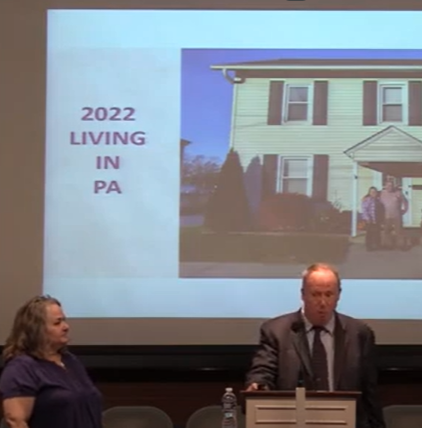
Not everyone can hear us give a full description of what we do, so it seems like a good time to give an overview. The video is from a missionary conference in Chester, Pennsylvania from 2022. (By the way, if you have been following my updates about my Spanish-language Bible study, it takes place at this same congregation). The video describes my teaching in ESEPA seminary, my books (most of which you can get on Amazon), my work editing the Bible in the SUN language for the 60 million deaf non-readers around the world. Karen gives details about her ministry “Levanta La Voz” (Raise Your Voice), which specializes in preventing sexual abuse in the church. I then conclude with thoughts about a favorite Bible prophecy, Matthew 24. Enjoy! Gary and Karen
We are WorldVenture missionaries to Costa Rica. Gary is professor of New Testament at Seminario ESEPA and is a blogger and author. Karen teaches at ESEPA and also specializes in sexual abuse and the church. They have four adult children who live in the USA.
I (Karen) just returned from a 2-week trip to Malaysia to assist with another cohort of the training I ran in November (Programme Essentials Training). And I attended the annual conference of the Child Safety and Protection Network. It was a long, tiring, and expensive trip, and the joy of travel and adventure were not driving my train, so to speak.
Add to this knowing I barely have time to unpack and repack for an upcoming WorldVenture regional conference that Gary and I will be attending in Panama April 13-17, where I will be teaching our local WorldVenture kids the body safety training I helped write 4 years ago.
The near constant temptation running through my head of, “You’re too old, you shouldn’t be doing this! These long plane rides aren’t good for your health. You’re frail, what if you fall and break your knee/hip/back implants in a foreign country? Is this really the best way to ‘use the Lord’s money’? Haven’t you worked long enough? Don’t you get to stay home and relax? Couldn’t you teach this online? It would be easier and cheaper, you know. You could still paint the kitchen in the evenings.” (Yes, I’m one of the weird ones that find painting rooms and houses relaxing and refreshing and our spiritual Enemy knows it’s my weak spot!).
I collapsed on the bed of my hotel room after 40 hours of travel across the Pacific, not knowing whether it was day or night on my body clock, nor which meals I’d really eaten on the journey. Was I more tired or hungry? No matter, I was alone in a strange city and didn’t know where to find food, and the bed was right underneath me. Sleep would win!
The alarm clock woke me 2 hours later to meet my friend and co-worker for dinner. SHE knew where to find food, so I put myself in her capable hands. One of the first things she shared was that her trip here (from Lynchburg, VA) was WAY harder than mine, due to storms and ground-stops in many US cities. She arrived a full 24 hours late and barely got a night’s sleep before her first speaking engagement. She was even more tired and dazed than I was. But as she was speaking to parents of children in the local international Christian school, one of the women was obviously tearing up and becoming very emotional. She rushed up to my friend to speak afterwards.
This local woman shared that she had professed to accept Christ many years ago but was not allowed to go to church or have a Bible. She did the best she could but never knew how to grow in her faith. A month ago, she had been crying out to God for help, and he impressed upon her that she had to go to this specific workshop (which was not about growing in faith) taught by my friend. The woman got the sense that this was where she would get the answers to her questions. Something my friend said made her realize they had some things in common, even that they had once lived a few blocks apart, in a country very far from Malaysia, and yet never met. So, she asked my friend how to grow in her faith in Christ. My friend said “Well, for a start, you need to be around other Christians.” And as WE were talking about it, it occurred to us that God had actually made that very point by bringing my friend literally halfway around the world to meet this woman face-to-face! Community, fellowship, being in the same place at the same time to sing, pray, hear God’s Word, be taught and encouraged, love and BE LOVED, is a core tenet of Christianity. Jesus Himself put it into action by coming to earth as a complete man and sharing the Good News face-to-face with people who wanted to know God better.
Of course there are times when teaching and fellowshipping online has to make do, when there is no other way. I can’t fly to India every week to teach my friends there. In any given year I spend more time working with and teaching people online than in person. And I praise God that technology allows me to reach people that I otherwise would not be able to do!
But obviously there is still an important place for the expenditure of time, energy, and money to do in-person events. Sometimes we know why ahead of time, sometimes we find out when we get there, and sometimes we never know. But we missionaries have seen, over and over again, how God has a special place in His heart for bringing people together face-to-face to allow them to know Him better. His resources are infinite, and He obviously thinks his money is well-spent to fly a hundred of us to Malaysia to meet up with His Body there, and He has the resources to do it.
That wasn’t the last time this subject came up, either. A week later I received a message from our seminary in Costa Rica, ESEPA, asking if I’d be willing to create a new course for the bachelor’s level counseling program, on working with survivors of sexual violence. It has been something I’ve dreamed of for several years, so the answer had to be yes, in spite of the fact that the timing will make it nearly impossible for me to do on time. Since we were very busy, I didn’t even have time to start praying about the curriculum. But the next day, in the conference, I went to an interesting workshop on trauma-informed responses – this is a technical term that means, when we counsel people, we have to take into account what trauma they have endured. I sat there stunned, with tears in my eyes, realizing that this material would be perfect for my new course! Again, in addition to the miracle of God providing information I needed for the new job He had just given me to do, He had brought the speaker and me together by bringing us to Malaysia to attend this conference!
You are one of the ways He provides those resources to us. I want you to know that God is using your prayers and financial gifts in amazing ways! He is training up the next generation of child safety workers in mission agencies, Christian schools, and churches. He is spreading the message that His Word does address abuse, how to prevent it, and how to help when it happens.
I am also incredibly excited to share with you a new resource that just hit the shelves! My friend and co-teacher Lisa J. Radcliff has published another book! It’s called God is for Me: A Biblical Character Study of God’s Heart for the Sexually Harmed. I highly recommend reading it, gifting it to friends and church leaders, and leaving a review on Amazon to help spread the word about it as far and fast as possible!
PRAYER, Please! PRAY for Gary as he continues through the Old Testament, giving the finishing touches to the Symbolic Universal Notation (SUN) Bible for the deaf and deaf-and-blind non-reader. He is about 40% through and would like to finish in 2026. PRAY for Gary and Karen. BOTH will be teaching courses at ESEPA from May-August! THANK THE LORD. Gary had one last book, already out in Spanish, that he wanted to publish in English. It’s taken several years, but he just now signed a contract to publish his collection of technical essays, WHEN THE COMFORTER COMES: THE HOLY SPIRIT AND HIS WORK IN THE CHURCH. See the Spanish version HERE. PRAY for Karen, who will have her other knee joint replaced, in April.
First of all, I have a new website that contains ALL of my books in English and Spanish. Check out http://shogrenauthor.com The latest book is at the top of the page: Iceberg Ahead!When God’s servants crash into cold, hard reality.
TODAY’S STORY: Breaking Down Gary’s Ministry Hours!
So, I did some calculations:
On average, I spend 50% of my ministry time on MISSIONARY TEACHING, which includes course prep, classroom, grading papers, mentoring, blogging, speaking at conferences or on podcasts. The years I have a major writing project, that captures many, many hours of my time.
And I spend maybe 45% of my time on what is broadly MISSIONARY EVANGELISM. We usually picture evangelism as approaching individuals or preaching to a crowd. For me it’s working on a Bible translation for the deaf non-readers around the world. Symbolic Universal Notation was created in 2016 and the entire Bible should be done late this year or in 2027. This hidden people group of 60 million will “hear” the gospel for the very first time. https://missionsbox.org/press-releases/wycliffe-associates-publishes-new-testament-in-new-language-created-for-the-deaf-and-deaf-blind-communities/
So, TEACHING and EVANGELISM account for about 95% of my ministry hours.
(I’m not including as ministry hours: time in prayer, Bible study, meditation, reading spiritual books. That is “me” time, not ministry time.)
What about the remaining fraction – the, let’s see, the roughly 5%? SERVE THE NEEDY. One year I helped build homes for Habitat for Humanity in Costa Rica; several years it was going out early Sunday mornings to feed to the homeless in the streets of the capital. And since last year, it has meant heading out early to load the car and delivering lunch and dinner to shut-ins for Meals on Wheels.
With today’s sharp polarization of American politics, Christians might conclude that as long as they vote a certain way (right, left, center, libertarian, whatever), they are already doing their part for the needy.
James had a different opinion: “Religion that is pure and undefiled before God the Father is this: to visit orphans and widows in their affliction…and to keep oneself unstained from the world.” (James 1:27). Or Psalm 138:7 – “Though the Lord be high, he cares for the lowly.” Ministry to the poor and purity before God; not just one or the other. Both/And.
This is why I try to carve out a small 5% to actively SERVE THE POOR. As shown on this pie chart!
Something to think over – we all have a gift, we all specialize in one thing or another. But even Timothy – that master church organizer – was asked also to “do the work of an evangelist.” Like him we might want to “mix it up” with other colors of the ministry palette.
This month Gary says: I have been professor at Seminario ESEPA since we graduated from language school in 1999.
My main focus is the New Testament, and typically on the graduate level (master’s degree). Last term I taught Exegesis of Luke, and that involved many facets, including a great deal of them working in the Greek text. But I also serve as MENTOR for students who are writing their master’s thesis. What is this all about?
A THESIS is the final project before they graduate with a Master’s Degree in Biblical Exegesis. They show that they have “mastered” all the relevant areas (Hebrew, Greek, exegesis, Bible interpretation, Bible background, theology, teaching experience). Because of the investment in time for a professor, I typically work with no more than one protégé per year.
What does a thesis look like? It’s a document of about 100-130 pages; its main thread is to prove some point that the student has developed. He or she will choose a method and also explore all the bibliography that we can get our hands on (this includes material I send them from Pennsylvania). They need to offer some original contribution: for example: “I will seek to prove that X is true, based on the Greek exegesis of ‘Son of man’ references in the book of Revelation and their roots in the Old Testament.”
This year I was asked to work with WERNER. I was happy to do so, because I had had him in class and found him a reliable worker.
My first step with Werner was in April 2024, when I read his preliminary research proposal (technically called an “anteproyecto”). He was going to explore particular aspects of “John’s Christology” (the doctrine of Christ in the gospel of John), using such-and-such methods, and giving a preliminary list of 40 books and articles he wanted to use. He also had prepared a calendar for finishing it.
Since then and this summer, it was back and forth between me and Werner. He would send me a dozen pages, I would comment on them, he would make changes, and after more weeks send me some more material. Brick by brick the building grew, until this August, when I told him that in my opinion, he was ready to turn it in to ESEPA for approval.
This past Friday was a milestone: he stood before the “jury,” a group of four examiners, including myself. He gave a summary of his work for about a half hour, then received questions from professors who had been appointed to read and evaluate its quality. The last stage I had with my student was to “prep” him for this jury: what sorts of questions he could expect; how to present himself; how not to say too little or too much when asked a question; what to do if he doesn’t know the answer. And to dress with coat and tie! I sent him emails during the last few weeks, asking how he is feeling, giving him boosts of confidence.
The jury lasted two full hours. One of my questions was, “Este capítulo en el estudio de Juan está inevitablemente vinculado con Rudolf Bultmann. . . ¿Podría señalar dos o tres formas en que, a su juicio, él perdió el rumbo?” (“This chapter in John’s study is inevitably linked with Rudolf Bultmann . . .. Could you point to two or three ways in which, in your opinion, he lost his way?”). The question, by the way, was easier than it might appear!
After the exam, which I thought went very well, we dismissed the candidate. Werner went out for some coffee and fresh air while we discussed his presentation. Each made various comments, and we then voted: Werner received a unanimous vote that he “Passed” his project, and that will be entered into the academic register. I believe this was his last barrier to graduating this January. Werner was sent for and the jury chairman announced that he had passed. Hearty handshakes, claps on the back, smiles, “¡Bien hecho!” (Well done!), and the meeting broke up – his family was waiting to take him to lunch.
I contacted him later that afternoon to ask how he felt, suggesting he might want to decompress over the next few weeks. I have led maybe a dozen students through their projects and “defenses”, plus the one I myself did in the 1980s, and I know the importance of a cooling-off period!
______________
The majority of ESEPA’s students work on a bachelor’s degree at a Bible college level, which prepares them to be pastors, missionaries, counselors, and other Christian workers.
For advanced students like Werner there is a master’s degree level, what in America we call a seminary program. It prepares men and women who in the future will prepare other Christian workers.
Think of 2 Timothy 2:2 – “what you have heard from me in the presence of many witnesses entrust to faithful people, who will be able to teach others also.” The master’s graduates will be “able to teach others who in turn will be able to teach others who in their turn will be able to teach others, ad infinitum.”
It is not easy to get into ESEPA’s master’s program. As you can see, it’s not easy to get out of it either! But we now have Werner and other new graduates whom the Latin American church can deploy as teachers, writers, thinkers. And that’s one of Gary’s major life goals.
: Sometimes it takes longer than I expect to process what I’ve experienced: understand what happened, name the feelings, feel them, and move forward into a new normal. I’m still processing my health scare of April 2024, and I’d like to share with you what I’ve learned. A year ago, we shared with you that I was diagnosed with massive blood clots in my right leg and both lungs. My healthcare providers didn’t explain much at the time, but now that the crisis is over, every new doctor looks at me like I’m a ghost, clearly surprised and unsettled to see me alive. Eventually I understood that I had not “almost died”, but I “was dying” then in the ICU. Clearly God reached down, intervened, and gave me my life back.
Of course, I praise Him for that healing and the opportunity to continue to serve Him by teaching leaders about child safety! But there’s more. I was in the ICU for 3 days, waiting until the new meds reached a therapeutic level. Just like John Bunyan found prison a good place to get his writing done, I’ve usually found hospital stays to be a great way to get work done! But I hadn’t planned this to be a long visit, so I didn’t bring any work with me. Many of our family came and kept me company one day, and Gary was there as long as he could be, but there was still a lot of free time.
Apparently, the ICU was slow during my stay, so my nurses had time to hang around more than usual. And each one of them was a Christian. They instantly connected with me and wanted to know about our missionary work, especially my work in child safety. They went out of their way to make me as comfortable as possible on total bed rest and looked for excuses to come in and rejoice in our shared love for our God. It really felt like one long praise and worship service! One nurse even asked me to share how we knew God was calling us into missions, because she was feeling God tugging on her heart to do the same.
At the time, I was just surprised to be surrounded by fellow Christians and enjoyed it. But now that I know the full extent of my health situation, it’s clear that there was a lot more going on. God knew I was dying. He was fixing the problem, but He made sure to be there IN PERSON, in the form of His Body, so I would be well cared for, protected, and loved during such a vulnerable time. God knew ahead of time and went to a lot of trouble to organize staff scheduling and who-knows-what-else to literally be there with me bodily, by surrounding me with His Body, members of His Church. As I look back, His presence with us was so real, it was a sacred time.
But that wasn’t the end of the lesson. By September, I was well enough to travel with my friend Nancy to the Getty Sing! Conference in Nashville. Most of you know that my college training was in Bible and music. I treasure God’s Word, and music is one of the most significant ways I commune with Him. A Getty conference is a lovely blend of both! I treasured the time singing God’s praises with 4000 people, a professional band, and orchestra! But more significantly, if you take a quick survey of the Gettys’ music, you’ll notice that most of their songs address our own death and resurrection. The words are expressions of faith in God’s sovereignty and wisdom, and the hope we have in Him. So for 3 days, just as I was starting to grasp how close to death I’d been, and how suddenly it had happened, I found myself singing song after song filled with words of faith in God’s victory over death: “Sing the vict’ry of the Lamb” , “I know how the story ends, we’ll be with You until the end”, “Now and ever we confess, Christ our hope in life and death”. (If you look at “Christus Victor” on YouTube, it was recorded there with all of us singing in the background. The other two songs I quoted are Shane and Shane’s “You’ve Already Won” and the Gettys’ “Christ Our Hope in Life and Death”.)
But there’s more! Gary wrote a commentary on 1 Corinthians, and lately he’s preached several sermons on chapter 15, the resurrection chapter. Last Sunday, preaching about it in Ocean City, New Jersey, Gary commented that he thinks it’s one of the most important doctrines, and is woefully under-preached. That struck me. My own husband being used of God to continue the lesson He’s teaching me, reinforcing that “everlasting life” means that at Christ’s return, we will all be given our permanent, real body. What joy it will be after death living life in a body with our loved ones in their bodies, enjoying eternity together, wholly body and spirit, in the presence of our God.
God has allowed me to understand what happened to me and taught me to interpret it in the light of the truth of His Gospel. I’m sharing this with you because I suspect you too have experienced very difficult things, and I know God was working behind the scenes during them to sustain you and provide what you needed. I hope you will ask Him to show you how He took care of you, highlight the members of His Body who provided for you, and interpret what happened through the truth of His Word. Then please take some time to praise Him for what He has done for you and worship Him using your own beloved songs, hymns, and spiritual songs.
Sometimes it takes longer than I expect to process what I’ve experienced: understand what happened, name the feelings, feel them, and move forward into a new normal. I’m still processing my health scare of April 2024, and I’d like to share with you what I’ve learned. A year ago, we shared with you that I was diagnosed with massive blood clots in my right leg and both lungs. My healthcare providers didn’t explain much at the time, but now that the crisis is over, every new doctor looks at me like I’m a ghost, clearly surprised and unsettled to see me alive. Eventually I understood that I had not “almost died”, but I “was dying” then in the ICU. Clearly God reached down, intervened, and gave me my life back.
Of course, I praise Him for that healing and the opportunity to continue to serve Him by teaching leaders about child safety! But there’s more. I was in the ICU for 3 days, waiting until the new meds reached a therapeutic level. Just like John Bunyan found prison a good place to get his writing done, I’ve usually found hospital stays to be a great way to get work done! But I hadn’t planned this to be a long visit, so I didn’t bring any work with me. Many of our family came and kept me company one day, and Gary was there as long as he could be, but there was still a lot of free time.
Apparently, the ICU was slow during my stay, so my nurses had time to hang around more than usual. And each one of them was a Christian. They instantly connected with me and wanted to know about our missionary work, especially my work in child safety. They went out of their way to make me as comfortable as possible on total bed rest and looked for excuses to come in and rejoice in our shared love for our God. It really felt like one long praise and worship service! One nurse even asked me to share how we knew God was calling us into missions, because she was feeling God tugging on her heart to do the same.
At the time, I was just surprised to be surrounded by fellow Christians and enjoyed it. But now that I know the full extent of my health situation, it’s clear that there was a lot more going on. God knew I was dying. He was fixing the problem, but He made sure to be there IN PERSON, in the form of His Body, so I would be well cared for, protected, and loved during such a vulnerable time. God knew ahead of time and went to a lot of trouble to organize staff scheduling and who-knows-what-else to literally be there with me bodily, by surrounding me with His Body, members of His Church. As I look back, His presence with us was so real, it was a sacred time.
But that wasn’t the end of the lesson. By September, I was well enough to travel with my friend Nancy to the Getty Sing! Conference in Nashville. Most of you know that my college training was in Bible and music. I treasure God’s Word, and music is one of the most significant ways I commune with Him. A Getty conference is a lovely blend of both! I treasured the time singing God’s praises with 4000 people, a professional band, and orchestra! But more significantly, if you take a quick survey of the Gettys’ music, you’ll notice that most of their songs address our own death and resurrection. The words are expressions of faith in God’s sovereignty and wisdom, and the hope we have in Him. So for 3 days, just as I was starting to grasp how close to death I’d been, and how suddenly it had happened, I found myself singing song after song filled with words of faith in God’s victory over death: “Sing the vict’ry of the Lamb” , “I know how the story ends, we’ll be with You until the end”, “Now and ever we confess, Christ our hope in life and death”. (If you look at “Christus Victor” on YouTube, it was recorded there with all of us singing in the background. The other two songs I quoted are Shane and Shane’s “You’ve Already Won” and the Gettys’ “Christ Our Hope in Life and Death”.)
But there’s more! Gary wrote a commentary on 1 Corinthians, and lately he’s preached several sermons on chapter 15, the resurrection chapter. Last Sunday, preaching about it in Ocean City, New Jersey, Gary commented that he thinks it’s a very important doctrines, but is woefully under-preached. That struck me. My own husband being used of God to continue the lesson He’s teaching me, reinforcing that “everlasting life” means that at Christ’s return, we will all be given our permanent, real body. What joy it will be after death living life in a body with our loved ones in their bodies, enjoying eternity together, wholly body and spirit, in the presence of our God.
God has allowed me to understand what happened to me and taught me to interpret it in the light of the truth of His Gospel. I’m sharing this with you because I suspect you too have experienced very difficult things, and I know God was working behind the scenes during them to sustain you and provide what you needed. I hope you will ask Him to show you how He took care of you, highlight the members of His Body who provided for you, and interpret what happened through the truth of His Word. Then please take some time to praise Him for what He has done for you and worship Him using your own beloved songs, hymns, and spiritual songs.
We find ourselves being asked two specific questions: * How is Karen doing? * Is the bathroom done?
First, how is Karen doing? Karen is very well, thank you! After years of patient waiting, Karen had a knee replacement on March 18. She has had a steady recovery and she’s faithful at her physical therapy. At this point Karen is walking without a cane or walker and driving better than she did pre-surgery! Thank the Lord for this medical intervention.
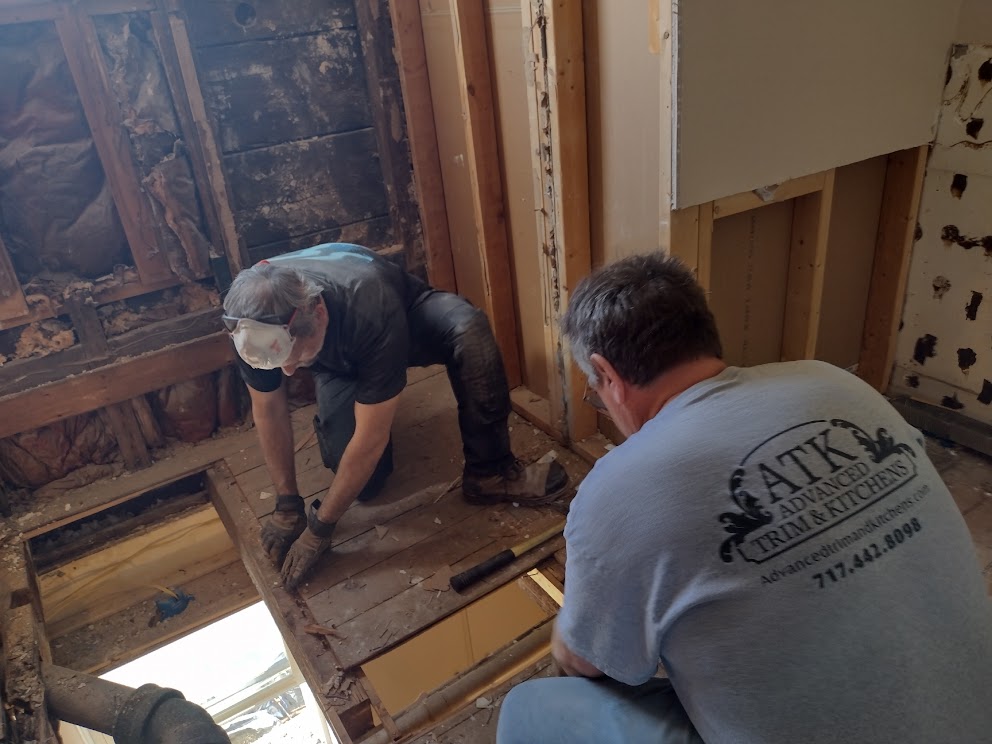
Second, is the bathroom done? Some details still need to be finished, but the headline is, Yes, the bathroom is up and running! If you haven’t been following the narrative: Karen was having trouble getting in and out of the bathtub/shower. She’d been trying to find a local contractor to do the work, but without success. And so, in our February newsletter we put out a call for people to help remodel the bathroom as a ministry to us as missionaries. And suddenly a team of Christian men stood up to be counted. Some to do Demolition and others to do Construction! They all arrived on March 1 to tear the old floor and fixtures out. As it turns out, the bathroom floor/kitchen ceiling was worse than we thought. Some of the joists were a mess. The watchword for the guys on the second floor was, “Watch your step or you’ll end up in the kitchen!”
Here is the BEFORE picture, on March 1:
Over the following weeks, the guys who did plumbing, electricity, and sheet rock came and went.
Here is the AFTER picture from the same angle!
Thanks so much Andy, Chris, Bill, Gary H., Dave, Buddy, and Paul. These men represented Woodlyn Baptist, the Bible Fellowship’s Board of Missions, Paradise Bible Fellowship, and Faith Bible Fellowship.
Plus – thanks so much to the people who sent us special donations for the project! Fortunately, we still have enough of your generous donations to cover the remainder of the project (bathroom details and kitchen ceiling).
Many thanks to the builders and to the donors!
PRAYER, Please! PRAY for Gary as he returns to the Old Testament to give the finishing touches to the Symbolic Universal Notation (SUN) Bible for the deaf and deaf-and-blind non-reader. PRAY for Gary as he pushes to publish three of his Spanish books in English versions. PRAY for Karen as she teaches online, specifically to a group in India. PRAY for Karen as she manages a team who are finishing the preparation of an important training program for the Child Safety and Protection Network. This program teaches mission agency and International Christian School leaders how to set up and evaluate an effective child safety program. PRAISE GOD for our new bathroom and for the brothers who did the work! Finally, we have hot showers on demand – one of the great modern inventions!
Answers to prayers are good news, but at times, for every answered prayer, more things need to be prayed for.
The answers to prayer? Editorial CLIE (Barcelona) has in the past year published two of my books; Publicaciones Kerigma has published yet another. All three are on the market, also on Amazon, but only in Spanish.
NEW prayer request: I have three available-only-in-Spanish books. But now I have three books that are totally ready to in English, and that I would like to publish.
I almost never use the word “unique”, but in all three cases I have searched carefully, and was able to find nothing similar in either language.
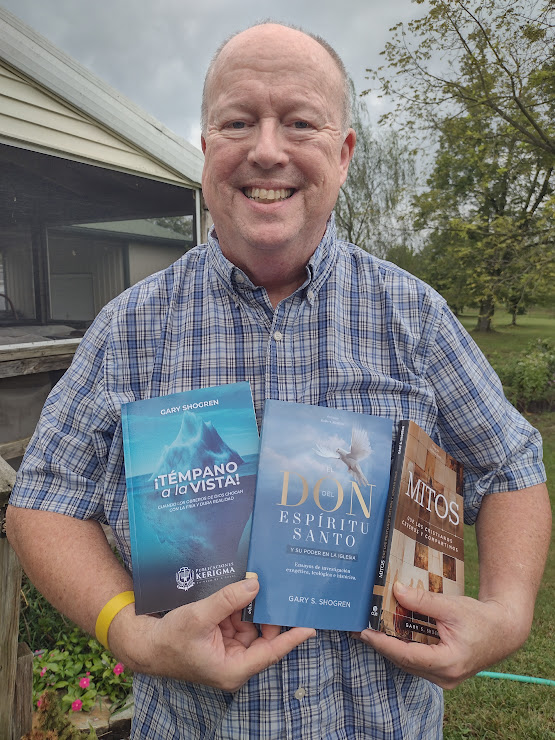
The one on the left, with the iceberg on it, will be Iceberg Ahead! When God’s Workers CRASH into Cold, Hard Reality. It is about how we deal with disappointments. I examine the many times when the apostle Paul had a collision and how he kept on going. I also develop character sketches of Christians in the 21st century, people who are undergoing the same trials.
The one in the center is a collection of essays I have written over many years: The Gift of the Holy Spirit and his Power in the Church.
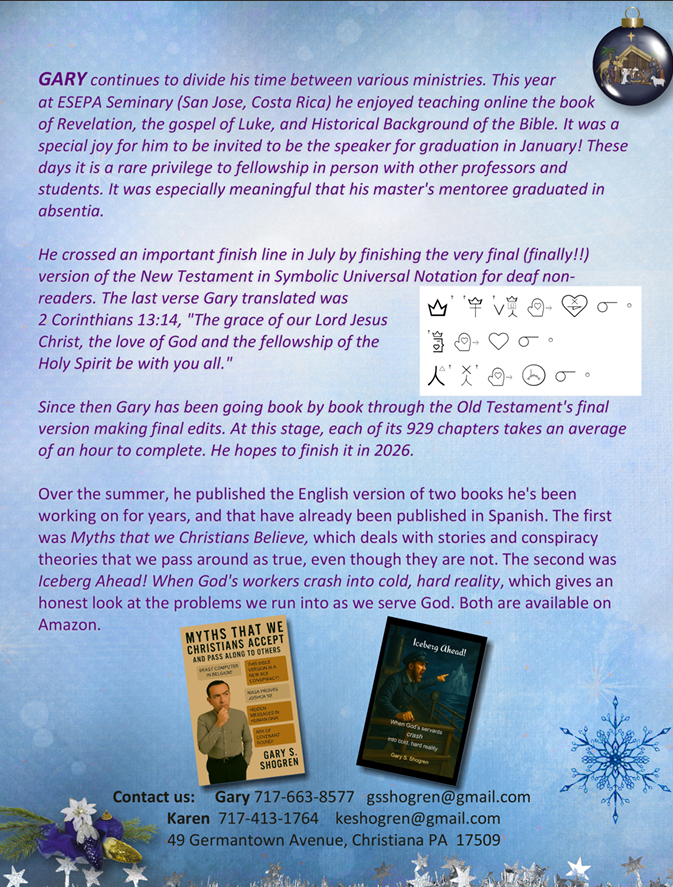
And finally, the one on the right just came out: Myths that Christians Believe and Pass Along to Others, on why we succumb to clickbait and circulate unfounded stories to millions. Examples: Did you see on “History” about how they discovered giant human skeletons? Or hear that Greek is the most precise language in the world? Or that human DNA communicates hidden messages from God in Aramaic? We deal with these and 40 other stories.
Hence, I AM LOOKING FOR 1, 2, or 3 English-language publishers to break this logjam.
PRAYERS for this venture, please! I am using these weeks to digitally pound on many doors, looking for interested publishers. Thanks! Gary
Prayer requests: * Please continue to pray for Karen’s health, as she has to deal with a combination of issues: blood clots; bad knees; arthritis. * Our support level has dropped over the last few months. Perhaps our churches would want to raise their giving by $50 a month? * Very specifically: we need to do some renovations to our upstairs bathroom in our Christiana home. If you would like to contribute or help with the job, please let us know! And please pray: this has been, literally, hanging over our heads for a couple of years!
I (Karen) would like to share about my recent ministry trip, and the organization with which I was working. The Child Safety and Protection Network (CSPN.org) is a consortium of mission agencies and international Christian schools who have come together to empower similar organizations to have an effective child safety program. It is a non-profit that uses mostly volunteers (member missionaries like me!) to accomplish its goals. WorldVenture is a member of CSPN, and I have found it to be the most similar organization to my own Levanta La Voz (Raise Your Voice).
So, my involvement with CSPN gives a double reward: in CSPN I can learn from like-minded people and extend the reach of Levanta La Voz, and I am able to use my own knowledge and experience to spread the word to missionaries around the world through CSPN. I am one of their educators, and last month I had the opportunity to help teach 20 mission agency executives how to set up or improve their own child safety program. Afterwards, I joined 4 others to spend 5 days editing that same training program.
We will continue editing and re-writing for the next 6 months before leading the next training in March in Orlando. Please pray for us as we finish the job, as it is a program that has the potential to protect thousands of children worldwide for many years to come.
Here are some more prayer requests for Karen: * I am also in the middle of my certificate program at ESEPA Seminary. In addition to teaching 4 students this year, I am training a new co-teacher and compiling all the student notes into a properly formatted workbook, complete with searchable Table of Contents. A big job! * A former student has gathered a group of people who want to take my virtual 8-week course in Spanish, and we’ll begin August 8. * I am still teaching my virtual 8-week course in English to a group of church leaders from India. Since they translate it as we go, we can only cover about 30 minutes of material each week, which turns it into a 48-week course! But I’m willing to keep at it if they are! I’m getting great feedback from them: the information is new, biblical, and helpful to them personally. The pastor said he’d looked for this type of information, but our program was all he could find. That encourages me that truly this is needed! * We are still sorting out various health problems in the aftermath of my serious blood clots. I need good medical professionals, wisdom, pain relief, and patience.
ALSO! Gary’s new book just came out, for now only in Spanish – an English version under the title Myths that Christians Believe and Pass Along might take place in the future! It has to do with myths and rumors that circulate among believers, and how to be more discerning. Here is a blog post from 2012, which later germinated into a book: Christians and myths – Open Our Eyes, Lord! (openoureyeslord.com)



 I am also incredibly excited to share with you a new resource that just hit the shelves! My friend and co-teacher Lisa J. Radcliff has published another book! It’s called God is for Me: A Biblical Character Study of God’s Heart for the Sexually Harmed. I highly recommend reading it, gifting it to friends and church leaders, and leaving a review on Amazon to help spread the word about it as far and fast as possible!








 Karen Shogren
 Gary Shogren
 Shogrens in Costa Rica